The right repository depends on the place and authority at the event date. Municipality, parish and district can cover different areas. Identify the place before expanding surname searches.
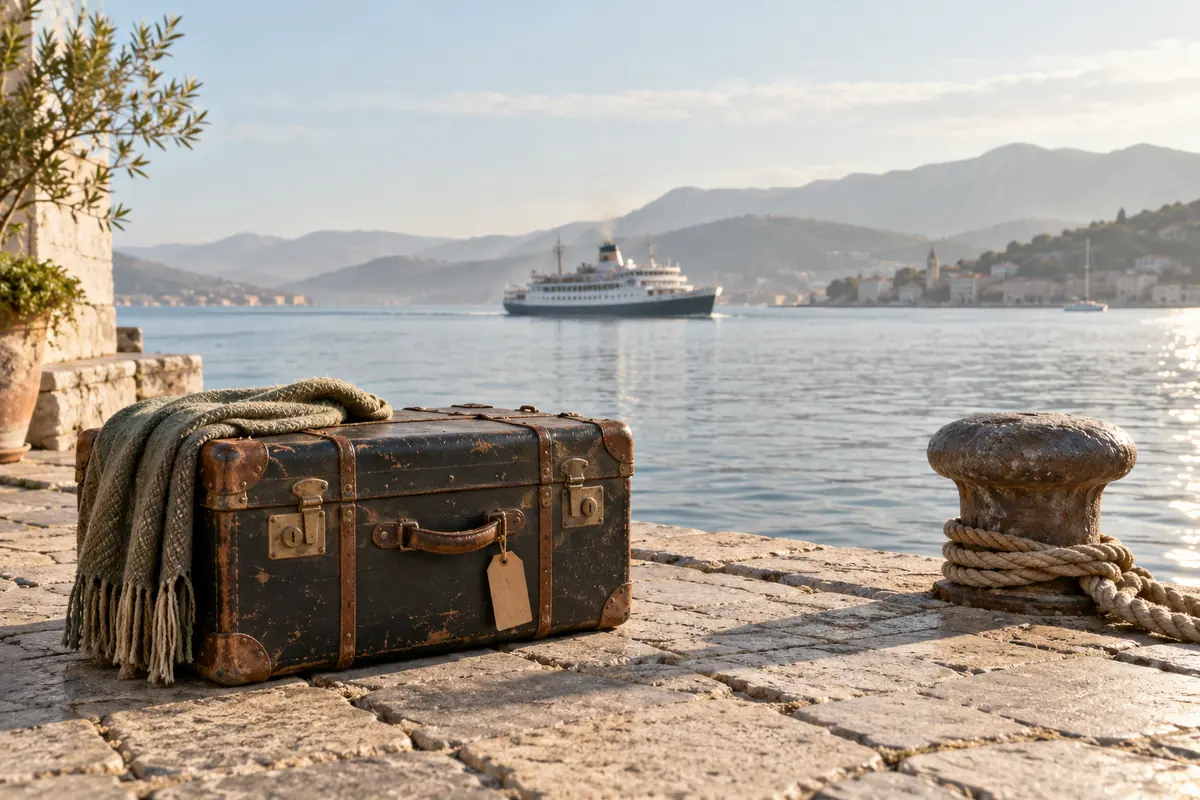
Trunk on a quay, evoking family migrations. Illustration; fictional scene, not documentary evidence.
The method, step by step
Transcribe the place name exactly with surrounding words. Note language, date, record and administrative qualifiers. Retain uncertain readings with the image before normalising.
List candidate places and compare parish, region, travel routes and other recorded locations. Use maps and institutional descriptions. Geographic proximity alone does not identify a place.
For the selected place, identify authorities producing the record type at that date. Locate the current repository and series. Where borders changed, search documented language variants.
Keep a place record with original name, standardised name, dated jurisdiction, identification source and repository. Link it without replacing the original wording. Revise it when new evidence conflicts.
Algeria: check which copy is held by ANOM
As of 21 November 2026, ANOM reported maintenance on its civil registration and military recruitment databases. While they are unavailable, identify the municipality and date range, then find the collection in the inventories. Resume searching the registers when the databases reopen. Archives nationales d’outre-mer — Aide à la recherche ↗
ANOM holds an incomplete copy of the registers classed as European civil registration. A name search is offered for entries from 1830 to 1904. From 1905, search by territory, municipality, record type and date. Record which years are actually covered for the municipality. Archives nationales d’outre-mer — Les recherches généalogiques ↗
The original registers classed as European and the registres matrices remained in Algeria. If ANOM copies omit the municipality or series, use the place and record type to identify the relevant repository. Log the index search and the coverage check separately. Archives nationales d’outre-mer — Ce que vous ne trouverez pas aux ANOM ↗
These fictional situations separate a clue, a hypothesis and a conclusion. Open the analysis after choosing your next check.
Specific question
Identified record
Compared information
Explained conclusion
Worked exercise · fictional data
A birthplace is not a nationality
Two records name the same birth town but use different country names. The records were created at different dates.
See the reasoning and next search
What remains to be established
The variation may reflect a border, a translation or an inaccurate statement. It alone proves neither movement nor citizenship.
The useful next check
Keep the original wording. Identify the town, namesakes and administrative jurisdiction at each record date. Seek a specific citizenship record rather than inferring citizenship from place. Keep the transcribed name, identified place and proposed match separate. For places sharing a name, seek jurisdiction and another family clue before merging journeys; a present-day map search alone does not resolve the match.
An index helps discovery; reading the record and matching people are still necessary. The National Archives guidance below concerns US censuses.
A Canadian census must be read with its year and administrative geography. LAC’s search covers censuses from 1825 to 1931; early series and territories differ in content and survival.
Tick items as you read. Ticks remain only on this page and disappear when it is reloaded.
Dates below apply to each resource, not an exhaustive check of its collections. Read the limits and official pages before requesting records or visiting.
Choose the right archive collection
Start from the event, date and administrative location at that time.
Scroll horizontally to read all columns.
Decision guide
Criterion
What to check
Practical implication
Responsibility
Identify which repository holds the record type and period.
The present municipality and the authority that created the record can differ.
Availability
Separate surviving holdings, searchable inventories and digitised documents.
No online image does not mean the record has disappeared.
People with the same name
Compare spouse, occupation, address, witnesses and chronology before linking records with the same name.
If several people remain possible, keep separate hypotheses and identify the record that could distinguish them.
Register gaps
Locate missing years, municipal changes and undigitised holdings before drawing a conclusion.
Failure to find an online record does not establish that the event never happened.
Archive reference
An archive reference identifies a unit held by an archive within a collection or series. It helps request or cite the record even when no digitised image is available. Source: Archives nationales — Méthodologie de recherche
Worked example
Fictional search: an index names a child, but the needed date is missing from the digitised series. The researcher checks the catalogue, finds an undigitised volume covering the period and records where to request it. Absence from the index does not erase the family lead.
How do I know whether a register covers the period I need?
Check parish or municipality, date span and gaps noted in the catalogue. An unsuccessful search in a digitised volume proves little if the relevant series is missing or held in another collection.