
ROOT & GENEALOGY · Content updated on · Editorial method and sources
IrishGenealogy separates civil and church records. General civil registration began in 1864; non-Roman Catholic marriages were recorded from 1845. These historical starting points do not guarantee an image for every event.

The method, step by step
- Identify the registration district, distinct from the locality or parish. Try name variants and a reasonable date range; for a late-year event check the following registration year too. Do not change the event date to match the index.
- Record the Group Registration ID where supplied, then open the full page. Transcribe dates, places, parents, occupation and informant only where present. The informant’s role may explain their knowledge but does not prove an unstated relationship.
- Online coverage expands through successive releases. On 29 October 2026, official help lists birth images 1864–1925, marriages 1845–1950 and deaths 1871–1975, with pre-1864 marriages limited to non-Roman Catholic records. Check that help when a year is missing.
Read the records and build the connection
| Record element | What to record and check |
|---|---|
| District and event | Distinguish registration area, residence and event place. |
| Group Registration ID | Keep the ID with record type and year; read the linked image. |
| Dates and informant | Separate event and registration dates, then record the informant’s capacity. |
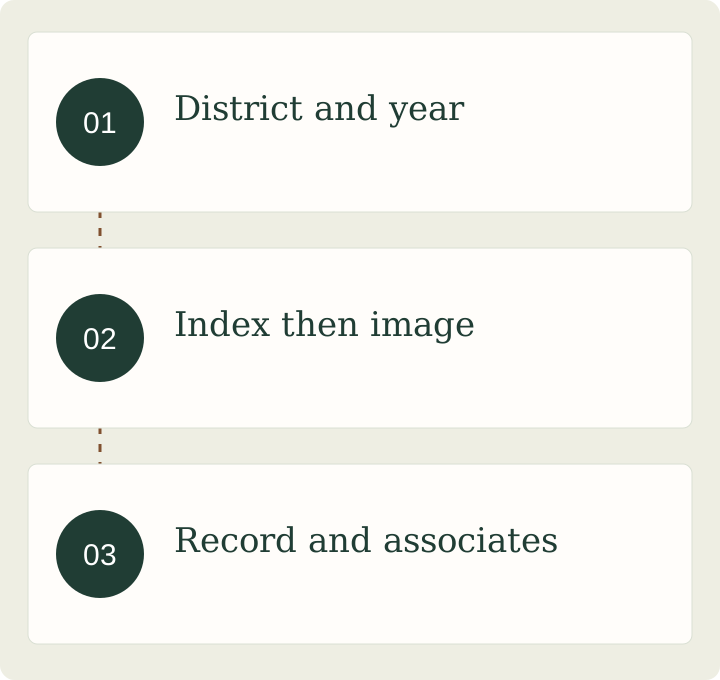
- District and year
- Index then image
- Record and associates
Tick items as you read. Ticks remain only on this page and disappear when it is reloaded.
Record in your research log
- District and event
- Group Registration ID
- Dates and informant
Sources & references
- IrishGenealogy — Civil records: Help ↗ (Resource review date : )