A death record documents the end of a life and may suggest birth or family information. Biographical details may come from an informant with limited knowledge.
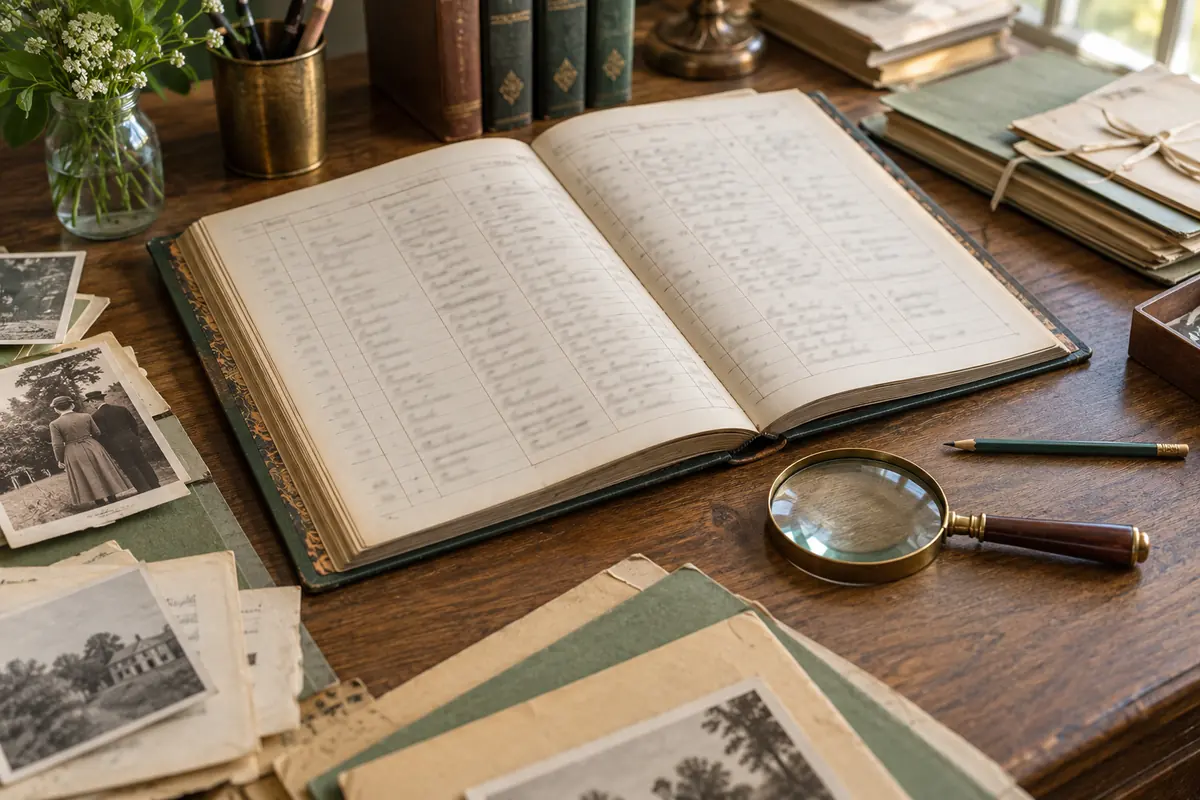
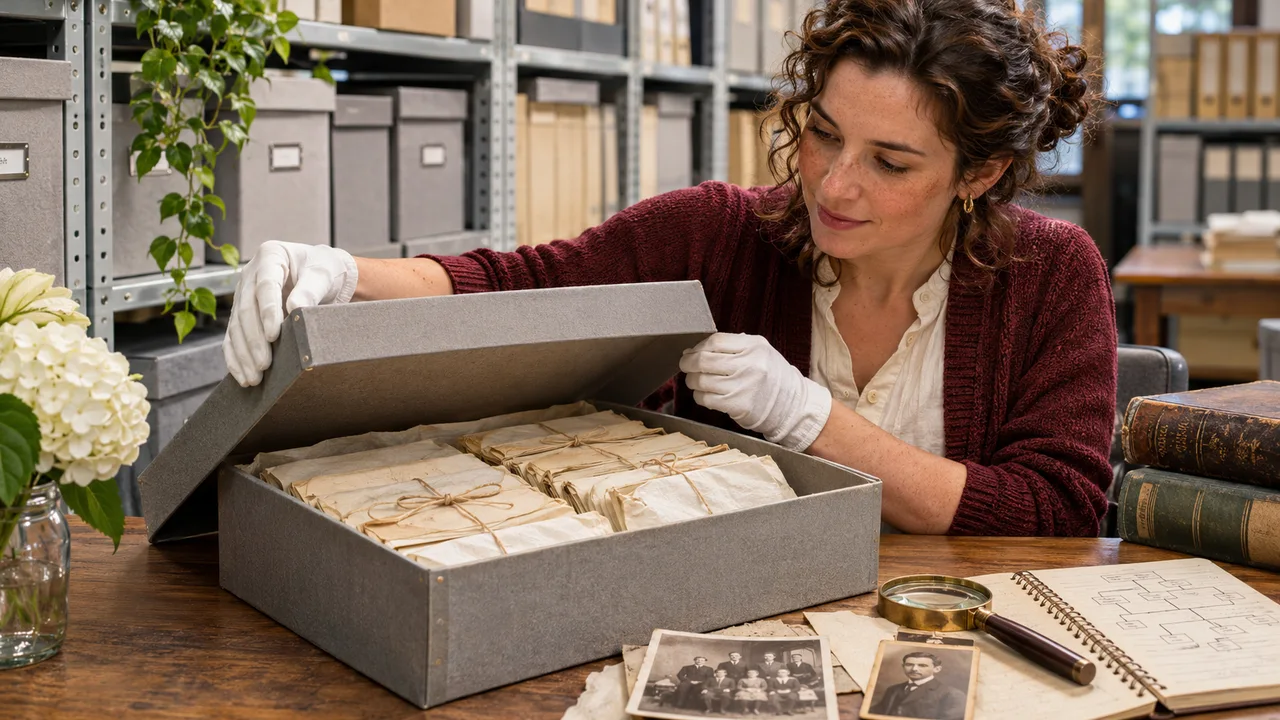
Register, folders and magnifying glass on a research desk. Illustration; fictional scene, not documentary evidence.
The method, step by step
Distinguish death, notification, registration and burial. Copy each stated date; nearby dates are not interchangeable.
Identify the informant and the stated relationship. Record reported age, birthplace and parents separately; seek an earlier source for confirmation.
Check address, spouse and occupation against the last known record. Death in a hospital or another place does not establish residence there.
If age is the only clue, estimate a birth period rather than an exact date. Add burial or estate records as separate cross-checks where available.
Read evidence without jumping to conclusions
These fictional situations separate a clue, a hypothesis and a conclusion. Open the analysis after choosing your next check.
Specific question
Identified record
Compared information
Explained conclusion
Worked exercise · fictional data
Two ages, one person?
In this fictional case, a census dated 10 April 1911 gives age 34; a death record dated 20 June 1936 gives age 61 under the same name.
See the reasoning and next search
What remains to be established
If both ages are exact completed years on those dates, birth falls in 11 April 1876–10 April 1877, then 21 June 1874–20 June 1875. The intervals do not overlap. This reveals a conflict, not yet two identities.
The useful next check
Reread the digits on the images. Compare spouse, address, occupation and informant, then seek a birth or marriage record. Keep both ages in your notes without averaging them.
An index helps discovery; reading the record and matching people are still necessary. The National Archives guidance below concerns US censuses.
The official probate search service covers England and Wales for deaths after 1857. It locates grants of representation and a will where one is included. Scotland and Northern Ireland have separate research routes.
Probate files document estate administration after death. A file may contain a will lodged with the court, while an intestate estate may produce letters of administration. Start from documented death and last residence.
Tick items as you read. Ticks remain only on this page and disappear when it is reloaded.
No. It provides an estimate to compare with an earlier record. Age may be rounded or supplied by an uninformed person; keep a range and cite the source.
Record all given names, occupation, place, date, spouse, informant and any witnesses. Distinguish the deceased from those supplying information and note any stated relationship. An age or birthplace reported by someone else may be approximate; a named person is not necessarily a relative.
Keep spelling, uncertainties, reference, page and image. If ages conflict, construct a birth interval and seek another record; do not average contradictory dates. Log municipalities, years and registers searched without success, separating interpretation from transcription.
Try the reasoning
Age at death conflicts with a birth date. What should you do?
Reasoning: Keep each statement with its record; examine identity and informant. Do not average conflicting dates.
Dates below apply to each resource, not an exhaustive check of its collections. Read the limits and official pages before requesting records or visiting.