Land records follow property and its holders. They may clarify residence or transfers but do not replace kinship evidence.
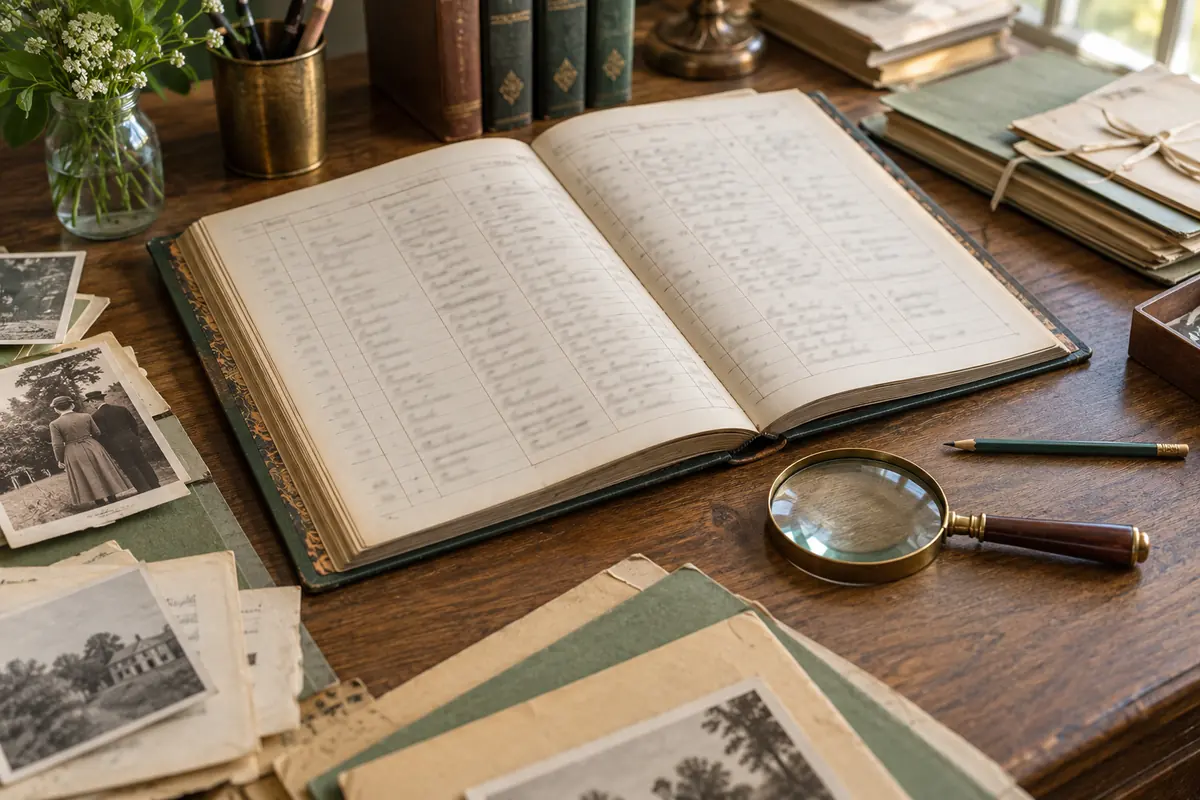
Register, folders and magnifying glass on a research desk. Illustration; fictional scene, not documentary evidence.
The method, step by step
Locate municipality, old address and period. Identify the local system: map, owners register, transfers or grants.
Connect the map to its section and parcel, then to the register. Retain old numbers when reorganisation changes boundaries.
Follow holder changes with their references. A register update, sale and inheritance remain distinct events.
Find associated deeds and compare occupation, spouse and residence. For each family link cite the explicit supporting passage.
Scotland: trace an address between censuses
If an address appears in the Scottish census of 1921, try the 1920 and 1925 valuation rolls. Search by town, parish and place, then read the image for the property description and separate entries for proprietor, tenant and occupier. In this index, Mc surnames were expanded to Mac. Scotland’s People — Valuation rolls ↗
The valuation roll is not a list of household members. Different names at the same address may reflect a change of tenant, a different informant or different dates. Compare the images of the roll and the census before concluding that anyone moved. Scotland’s People — Census returns ↗
Tick items as you read. Ticks remain only on this page and disappear when it is reloaded.
Dates below apply to each resource, not an exhaustive check of its collections. Read the limits and official pages before requesting records or visiting.