The national portal provides finding aids and guidance for French archival collections. Use it to identify the repository, then visit departmental or municipal archive websites for digitised registers. Searches may retrieve collection descriptions rather than every person named in a record.
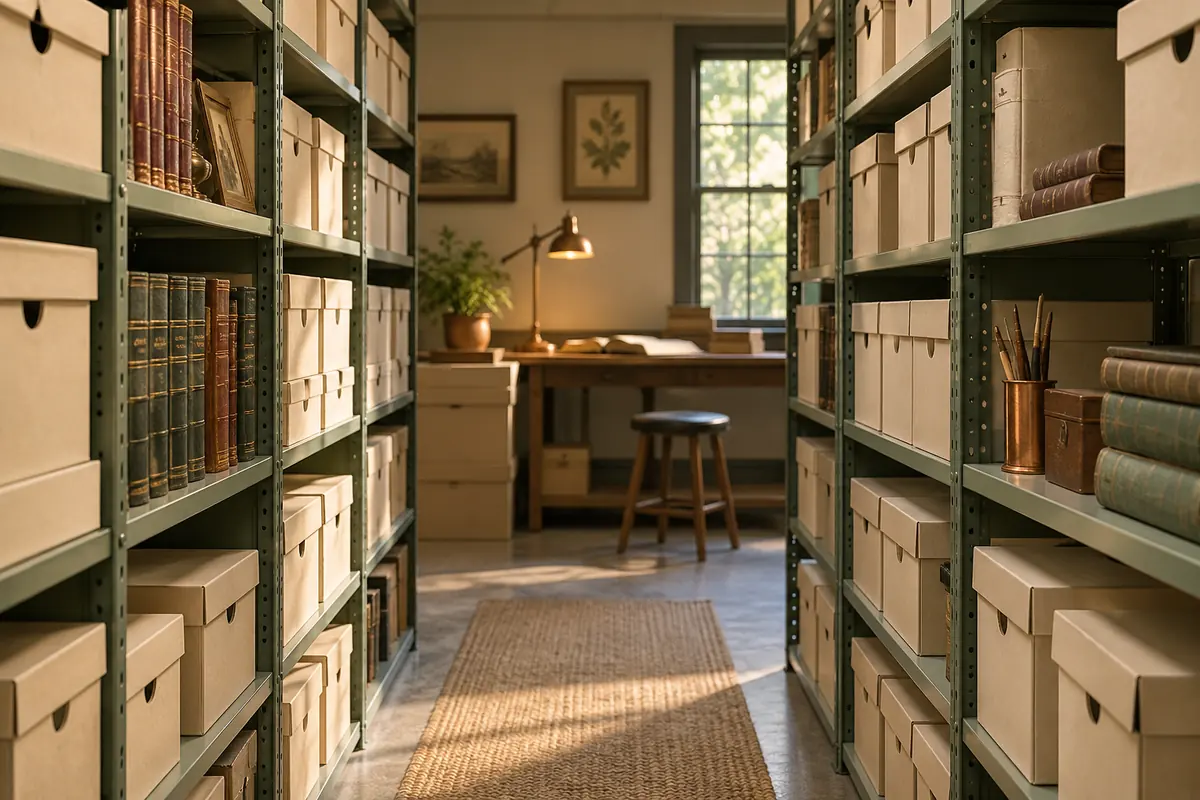
Shelves and archival storage boxes. Illustration; fictional scene, not documentary evidence.Visit the official resource ↗
Coverage and access
Resource type
Catalogue and guidance
Filter by territory
France
External link review
— Automated review limited: confirm on the official website
Collections to search
Finding aids; departmental and municipal repositories.
A workflow for this portal
Search a place and record type first. Open the finding aid, identify the repository and continue in its catalogue. Record the reference even without an image.
Access and copies
A description may lead to a reading room or an order. Check item access and copying conditions before travelling.
The review covers the guidance page, not every image or ordering service.
Source note
Read the description before looking for the image
FranceArchives provides collection descriptions and editorial resources. A description may lead to the repository without displaying the record. Keep repository, reference and date span, then continue on the source portal; these details remain useful without digitisation.
If unsuccessful, try name and place variants, then widen the dates. Record search terms and filters already tried. Absence from indexed descriptions does not prove absence from surviving holdings.
Try the reasoning
A name search finds nothing. Must the record be missing?
Reasoning: No: check coverage, variants and finding aids. A surviving record may not be indexed.
Dates below apply to each resource, not an exhaustive check of its collections. Read the limits and official pages before requesting records or visiting.
Choose the right archive collection
Start from the event, date and administrative location at that time.
Scroll horizontally to read all columns.
Decision guide
Criterion
What to check
Practical implication
Responsibility
Identify which repository holds the record type and period.
The present municipality and the authority that created the record can differ.
Availability
Separate surviving holdings, searchable inventories and digitised documents.
No online image does not mean the record has disappeared.
People with the same name
Compare spouse, occupation, address, witnesses and chronology before linking records with the same name.
If several people remain possible, keep separate hypotheses and identify the record that could distinguish them.
Register gaps
Locate missing years, municipal changes and undigitised holdings before drawing a conclusion.
Failure to find an online record does not establish that the event never happened.
Archive reference
An archive reference identifies a unit held by an archive within a collection or series. It helps request or cite the record even when no digitised image is available. Source: Archives nationales — Méthodologie de recherche
Worked example
Fictional search: an index names a child, but the needed date is missing from the digitised series. The researcher checks the catalogue, finds an undigitised volume covering the period and records where to request it. Absence from the index does not erase the family lead.
How do I know whether a register covers the period I need?
Check parish or municipality, date span and gaps noted in the catalogue. An unsuccessful search in a digitised volume proves little if the relevant series is missing or held in another collection.