A school list can place a child in time and space, sometimes alongside siblings. It does not replace a birth record. Archives New Zealand identifies primary-school class lists as a lead; availability elsewhere requires verification.
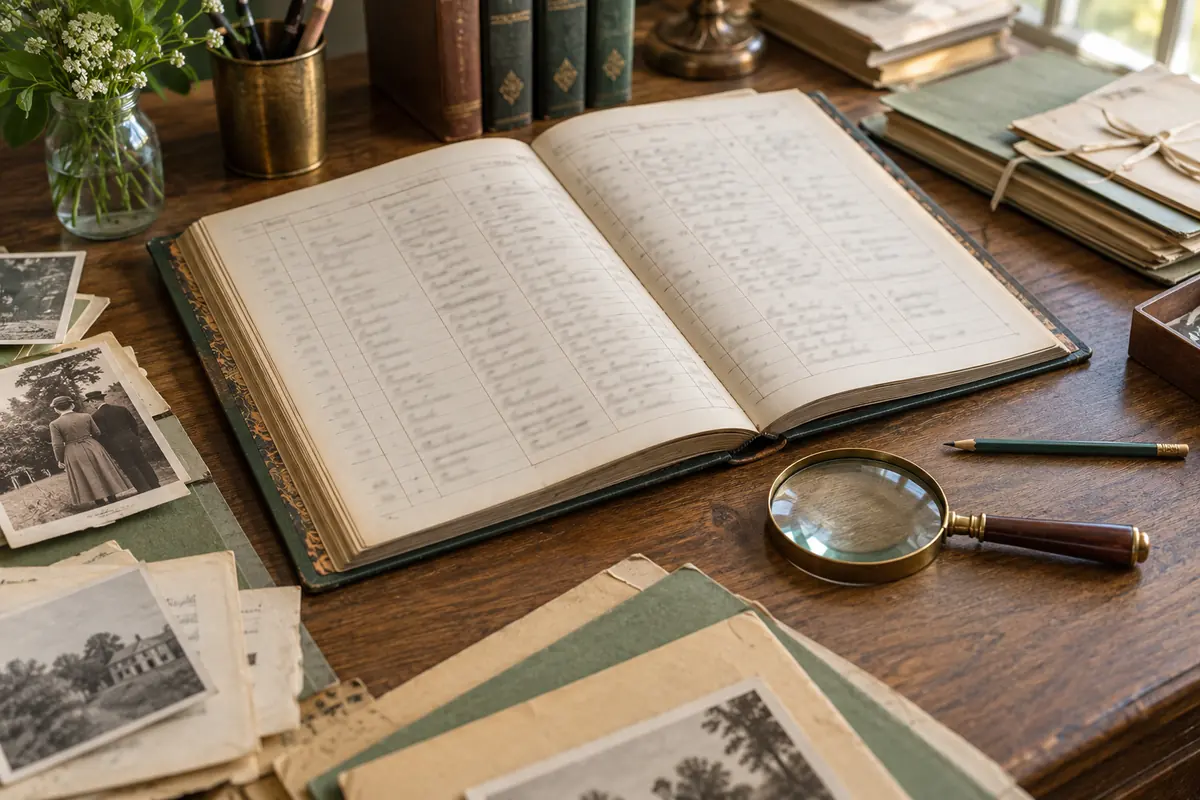
Register, folders and magnifying glass on a research desk. Illustration; fictional scene, not documentary evidence.
The method, step by step
Start with a school or dated address. Note school name changes, locality and plausible attendance period. A national child-name search may miss holdings described only by school.
Find the school or administration inventory. Separate class lists, admission, attendance and personal files: they serve different purposes and contain different data. Check access conditions before requesting.
Record school, year, class, original name and reference. Treat ages or dates as record statements. If guardians appear, transcribe the stated relationship without automatically assigning biological parenthood.
Compare children by address, periods and other records, then verify relationships in vital records. One surname in a school may identify cousins, namesakes or unrelated children; keep candidates separate.
Tick items as you read. Ticks remain only on this page and disappear when it is reloaded.
Dates below apply to each resource, not an exhaustive check of its collections. Read the limits and official pages before requesting records or visiting.
Choose the right archive collection
Start from the event, date and administrative location at that time.
Scroll horizontally to read all columns.
Decision guide
Criterion
What to check
Practical implication
Responsibility
Identify which repository holds the record type and period.
The present municipality and the authority that created the record can differ.
Availability
Separate surviving holdings, searchable inventories and digitised documents.
No online image does not mean the record has disappeared.
People with the same name
Compare spouse, occupation, address, witnesses and chronology before linking records with the same name.
If several people remain possible, keep separate hypotheses and identify the record that could distinguish them.
Register gaps
Locate missing years, municipal changes and undigitised holdings before drawing a conclusion.
Failure to find an online record does not establish that the event never happened.
Archive reference
An archive reference identifies a unit held by an archive within a collection or series. It helps request or cite the record even when no digitised image is available. Source: Archives nationales — Méthodologie de recherche
Worked example
Fictional search: an index names a child, but the needed date is missing from the digitised series. The researcher checks the catalogue, finds an undigitised volume covering the period and records where to request it. Absence from the index does not erase the family lead.
How do I know whether a register covers the period I need?
Check parish or municipality, date span and gaps noted in the catalogue. An unsuccessful search in a digitised volume proves little if the relevant series is missing or held in another collection.