Dutch register of deceased persons managed by the CBG. Extracts can connect a recent generation to civil records held in local archives.
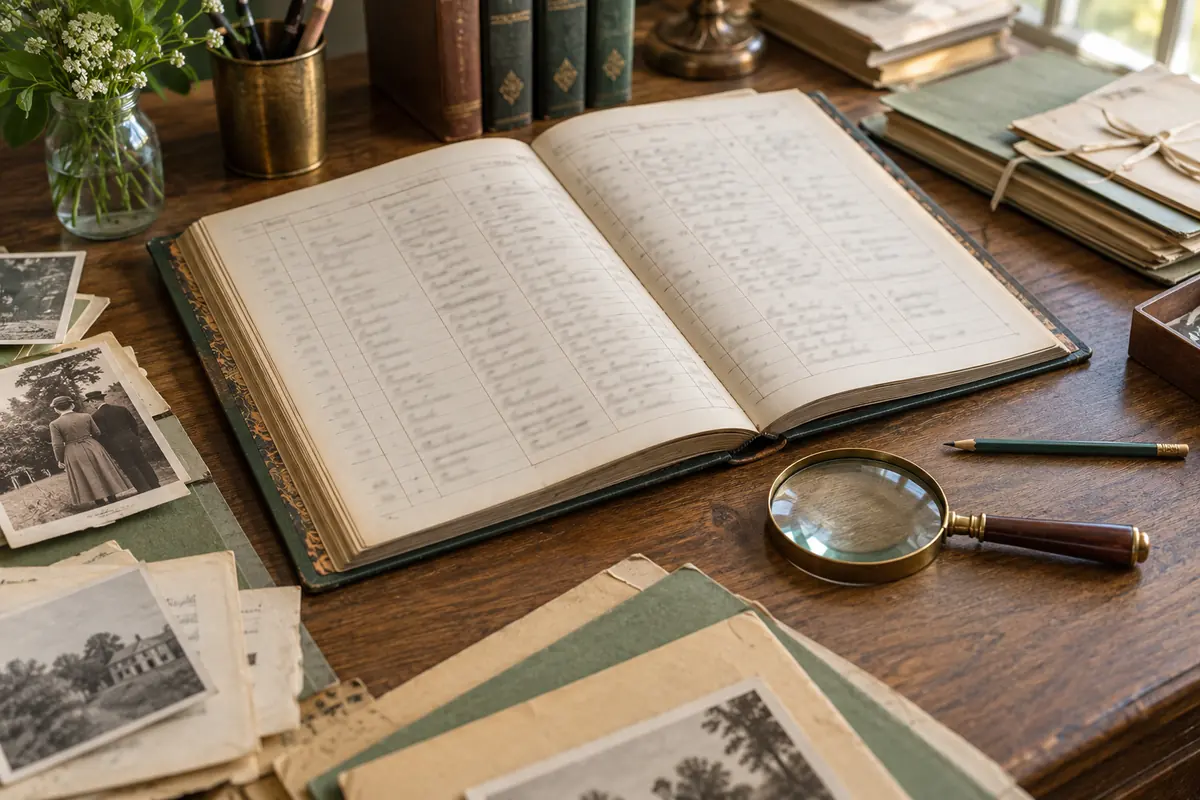
Register, folders and magnifying glass on a research desk. Illustration; fictional scene, not documentary evidence.Visit the official resource ↗
Coverage and access
Resource type
Registers and indexes
Filter by territory
Netherlands
External link review
— Official page consulted
Collections to search
Paper personal cards (persoonskaarten) for deaths from 1939 and digital personal lists (persoonslijsten) from October 1994.
A workflow for this portal
Gather the name, known dates and the municipality of registration at death. Check the CBG request terms and verify the resulting details against local records.
Access and copies
The CBG supplies extracts on request. Check its form, waiting periods and what information can be supplied.
The review covers the guidance page, not every image or ordering service.
Netherlands: which register to consult after a move?
For someone who was still registered in a Dutch municipality at death, check whether the CBG can supply an NRO extract. The address is an administrative registration. Compare it with a local record or a register documenting the move. CBG — NRO-uittreksels ↗
If someone moved abroad, start with the population registers (bevolkingsregisters) of the last municipality. Record any stated destination and check for an arrival record in that country. A departure without a clear destination leaves the question open. Nationaal Archief — Emigranten in de 19e en 20e eeuw ↗
Dates below apply to each resource, not an exhaustive check of its collections. Read the limits and official pages before requesting records or visiting.
Choose the right archive collection
Start from the event, date and administrative location at that time.
Scroll horizontally to read all columns.
Decision guide
Criterion
What to check
Practical implication
Responsibility
Identify which repository holds the record type and period.
The present municipality and the authority that created the record can differ.
Availability
Separate surviving holdings, searchable inventories and digitised documents.
No online image does not mean the record has disappeared.
People with the same name
Compare spouse, occupation, address, witnesses and chronology before linking records with the same name.
If several people remain possible, keep separate hypotheses and identify the record that could distinguish them.
Register gaps
Locate missing years, municipal changes and undigitised holdings before drawing a conclusion.
Failure to find an online record does not establish that the event never happened.
Archive reference
An archive reference identifies a unit held by an archive within a collection or series. It helps request or cite the record even when no digitised image is available. Source: Archives nationales — Méthodologie de recherche
Worked example
Fictional search: an index names a child, but the needed date is missing from the digitised series. The researcher checks the catalogue, finds an undigitised volume covering the period and records where to request it. Absence from the index does not erase the family lead.
How do I know whether a register covers the period I need?
Check parish or municipality, date span and gaps noted in the catalogue. An unsuccessful search in a digitised volume proves little if the relevant series is missing or held in another collection.